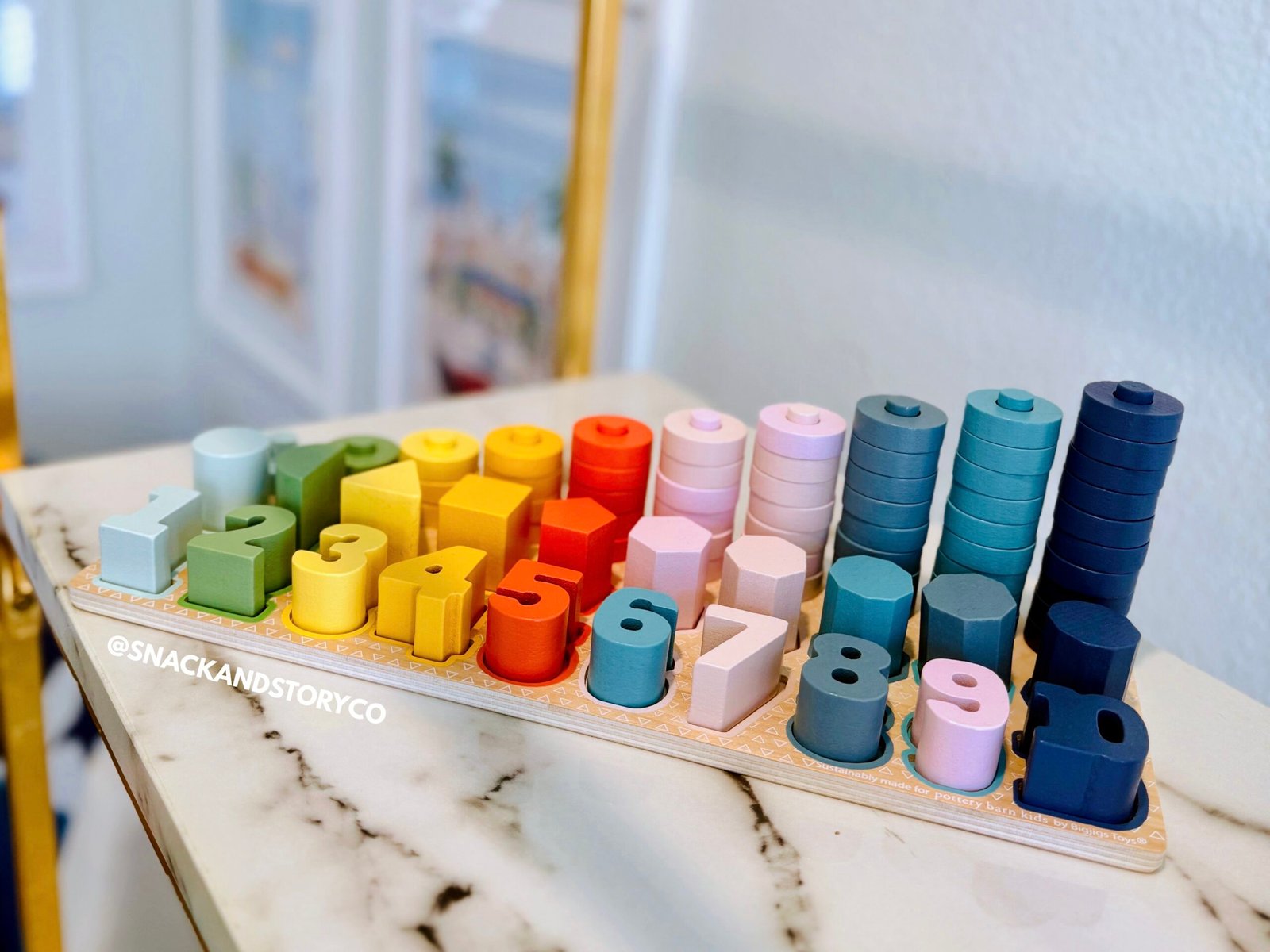
If you’ve ever watched your toddler line up cars, pour water between cups, or insist that the triangle cracker doesn’t belong with the round ones—you’ve already seen early math in action.
Math doesn’t begin with numbers or flashcards. It starts with curiosity, sorting, stacking, pouring, and patterns. And here’s the best part: if you’re engaging with your child during the day (and even if you’re just narrating life while tossing snacks onto a plate), you’re already helping them build real math skills.
Here are four fundamental early math concepts your toddler is exploring right now and simple ways to support them in your daily routine.
1. Sorting and Categorizing
You may notice your toddler grouping all the blue blocks, matching shoes, or lining up all the big animals on one side of the rug. This is sorting. It helps them identify similarities, organize ideas, and make sense of their environment.
Sorting lays the foundation for logical thinking and supports future skills like classifying, comparing, and problem solving.
How to support your child:
- Give your child time to sort items on their own, without correction
- Offer toys or objects in a variety of sizes, colors, or textures
- Narrate what they’re doing: “You’re putting the soft toys together. These feel different from the hard ones.”
- Turn cleanup into a sorting activity: “Can you find all the blocks first? Can we put all the big cars on the shelf and the little cars in the basket?”
- Use socks, cups, snack items, or puzzle pieces for casual matching games
2. Understanding Quantity
Long before toddlers can count, they begin to understand the concepts of “more,” “less,” and “the same”. When your child asks for more snack, notices an empty plate, or points out that someone else has two cookies, they are practicing number sense. “More,” “gone,” “mine,” and “again” may not sound like math words, but they absolutely are. Even without counting out loud, your toddler is learning about quantity every time they notice what they have compared to what someone else has.
This early awareness of quantity plays an important role in later math success.
How to support your child:
- Use quantity words throughout the day such as “a lot,” “just a little,” “empty,” or “all gone”
- Talk about how many items you see or share: “You have two, I have one. Which is more?”
- Let them help with pouring, scooping, or portioning food and play materials (such as rice, cereal, or water)
- When reading, count objects casually on the page: “Look, three ducks in the pond—one, two, three”
- Use familiar routines to practice: “We need two shoes. One shoe, then another. That makes two.”
3. Noticing Patterns and Sequences
Toddlers thrive on routine and repetition. They love the same songs, the same books, and predictable routines. This is pattern recognition, and it helps them begin to understand sequence, order, and rhythm. These patterns help them anticipate, organize, and feel confident.
Recognizing and creating patterns is a key skill that supports later learning in math, reading, and problem solving.
How to support your child:
- Sing the same songs, play peekaboo, or use repeating hand motions
- Let them line up toys or objects however they want and simply comment on what you see
- Build patterns with blocks, beads, or stickers and talk about what’s happening: “Red, blue, red, blue. What comes next?”
- Use movement patterns like clapping, stomping, or tapping
- Narrate daily routines: “First we brush teeth, then we read, then we go to sleep”
- Point out real-world patterns in clothing, nature, or home objects
4. Spatial Awareness and Measurement
From building towers to pouring water, toddlers are constantly exploring how things fit, move, and compare. When they squeeze into a cardboard box, stack blocks until they fall, or pour water until it spills, they’re learning about size, space, and how objects relate to each other. This is spatial reasoning, and it forms the basis for understanding size, shape, and measurement.
Spatial awareness also helps children develop early geometry skills and contributes to success in science, math, and even reading.
How to support your child:
- Provide open-ended materials like blocks, boxes, or stacking cups
- Talk about size and position with clear language such as “on top,” “under,” “next to,” or “taller than”
- Let them fill and empty containers during play and describe what’s happening
- Work on puzzles together and describe where each piece fits
- Point out size comparisons in daily life: “This ball is too big to fit in the basket. Let’s find a smaller one.”
The Takeaway
Toddlers don’t need math drills to start learning. They need room to explore, freedom to play, and a caregiver who notices what they’re already doing and puts words to it. When they stack, pour, match, or sort, they’re not just playing. They’re building the foundation for reasoning, problem solving, and confidence.
You don’t need to add anything extra to your to-do list. Simply living life alongside them—describing what you see, following their lead, and being present—is more than enough.
There’s no perfect script. Just everyday moments, noticed.
And that’s where the learning lives.
Learn More About the Research
Cartmill, E., Pruden, S. M., Levine, S. C., Goldin-Meadow, S., & Center, S. I. L. (2010). The role of parent gesture in children’s spatial language development. In Proceedings of the 34th annual Boston University conference on language development (pp. 70-77). Somerville, MA: Cascadilla Press.
Chan, J. Y.-C., Sera, M. D., & Mazzocco, M. M. M. (2022). Relational language influences young children’s number relation skills. Child Development, 93, 956–972.
Ginsburg, H. P., Lee, J. S., & Boyd, J. S. (2008). Mathematics education for young children: What it is and how to promote it. Social Policy Report, 22(1), 3-23
Johnson, N. C., Turrou, A. C., McMillan, B. G., Raygoza, M. C., & Franke, M. L. (2019). “Can you help me count these pennies?”: Surfacing preschoolers’ understandings of counting. Mathematical Thinking and Learning, 21(4), 237-264.
Sarama, J., & Clements, D. H. (2009). Early childhood mathematics education research: Learning trajectories for young children. Routledge
Sarnecka, B. W., & Lee, M. D. (2009). Levels of number knowledge during early childhood. Journal of Experimental Child Psychology, 103(3), 325–337.
Verdine, B. N., et al. (2014). Links between spatial and mathematical skills across the preschool years. Developmental Psychology, 50(4), 1264–1279



Leave a Reply