
Let’s turn quiet moments into meaningful ones without interrupting play.
Toddlers learn best through doing. But just because they’re focused on building, pretending, dancing, or resting doesn’t mean language isn’t growing too. Your narration during play helps them make sense of what they’re doing, without turning it into a lesson or a quiz.
You don’t need to ask a bunch of questions. Just observe and describe.
Here’s how to turn everyday play and downtime into language-rich, brain-building moments:
🚛 Independent or Parallel Play
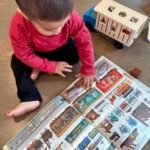
“You’re rolling the green truck. It goes fast! Zoom—under the table!”
- Describe what you see: movement, colors, pretend scenarios
- Match their pace: short, rhythmic phrases like “Stack up… crash!”
- Mirror their emotions: “That block tower made you smile!”
Why it matters: Supports pretend play, emotional attunement, and gives your toddler words without pressure to respond.
💭 Pretend Play or Role-Playing
“You’re feeding the baby doll. She’s hungry—nom nom nom!”
- Narrate their story as it unfolds: “Now the bear is driving to school!”
- Use emotional language: “Your puppy is sad. He needs a hug.”
- Let them lead and mirror instead of correcting
Why it matters: Develops narrative skills, emotional intelligence, and symbolic thinking.
🎨 Creative Time (Drawing, Arts & CRAFTS)
“You picked blue! You’re drawing a big circle—round and round.”
- Narrate their choices: color, size, shape, tool
- Describe actions, not outcomes: “You’re squeezing glue. Now you’re sticking the pom pom onto the paper.”
- Join in with your own version instead of correcting theirs
Why it matters: Builds descriptive vocabulary and supports creative expression without judgment.
🎶 Music Time or Dance Breaks
“You’re shaking the maraca—shake shake shake!”
- Narrate rhythm and tempo: fast, slow, quiet, loud
- Describe movement: twirl, stomp, clap, bounce
- Sing familiar songs and emphasize repeated phrases
Why it matters: Supports auditory processing, rhythm, coordination, and joyful connection.
🧗 Gross Motor or Big Body Play
“You’re climbing up—step, step. And… jump! You landed on your feet!”
- Narrate actions clearly: climb, crawl, jump, spin
- Use body part and movement language: knees, toes, stretch, balance
- Emphasize effort and safety: “That was a big jump. You stopped and looked first.”
Why it matters: Supports spatial awareness, motor planning, and builds confidence in the body and brain.
🧺 Cleaning Up Toys
“The puzzle pieces go in this basket. One, two… all cleaned up!”
- Narrate categories and locations: “Books on the shelf. Animals in the bin.”
- Use playful phrases: “The blocks are going to bed!”
- Turn it into a game: “Let’s race the toys home!”
Why it matters: Supports responsibility, sorting, sequencing, and builds closure around routines.
📖 Reading & Story Time
“The bear is sleeping—shhh. Oh! Now he’s awake!”
- Use expressive voices, gestures, and sound effects
- Pause and point to pictures as you describe what’s happening
- Encourage interaction without pressure: “You turned the page!”
Why it matters: Strengthens comprehension, vocabulary, and attention—all while deepening connection.
😴 Quiet Time or Resting
“You’re lying down with your blanket. Your eyes are blinking slowly.”
- Narrate in a calming tone: “The room is quiet. The fan is spinning.”
- Reflect their body cues: “You’re stretching your legs… cozy now.”
- Add predictable comfort phrases: “It’s time to rest. I’m right here.”
Why it matters: Helps toddlers settle, process sensory input, and feel emotionally secure.
EXPLORE THE NARRATE THE MOMENT SERIES
Looking for support across other parts of your day? Narrate the Moment is a series of real-life guides designed to help you bring language into everyday routines—without prep, pressure, or perfection. Each post focuses on a different part of daily life, filled with simple narration tips, easy scripts, and ways to turn ordinary moments into opportunities for connection and growth.
Check out the full series:
- ☀️ Morning Routines: waking up, brushing teeth, getting dressed, and more
- 🍽 Mealtime Routines: from hand washing to cleaning up skills
- 🧃 Snack Time & Midday Transitions: narrating everyday errands
- 🧼 Self-Care Routines: hair brushing, lotion, nails, runny noses, and even medicine
- 🌙 Evening Routines: bath time, pajamas, and calming phrases to end the day
- 🛝 On the Go – Outdoor Explorations & Beyond: nature walks, parks, and beach visits, with a focus on safety
- 🎒 On the Go – Big Transitions, Appointments & Social Moments: goodbyes, doctors visits, birthday parties and crowded events
Everyday routines are already full of meaning—these guides just help you put it into words.
We Want To Hear From You
Play doesn’t need structure or constant direction, and it doesn’t need to be interrupted, either. Sometimes the best thing you can do is simply observe and say what you see. No questions. No corrections. Just connection.
Try quietly narrating one small part of your toddler’s play—“You’re stacking blocks. Tall tower!”—and then let the moment breathe. You might notice they glance at you… pause to listen… or try saying it later. Let us know your favorite part of playtime in the comments.


Leave a Reply to Narrate the Moment: Self-Care Routines Cancel reply